AiGM Market / Opportunity collection
Find your next company.
Choose your route.
Choose a company package, explore a developed-business acquisition, commission a tailored company, or review investment opportunities in AiGM’s own ventures.
Companies for Sale and Tailor-made Companies are company-creation packages. Investment Opportunities is a separate route for prospective investors in AiGM’s own ventures. Each route explains its scope and next step.
The AiGM buy, build & sell pathway
Choose your starting point.
Build towards something bigger.
Planned launch · Q1 2027Start with a company package. Develop the product, customers and commercial evidence. Prepare a business a future buyer can assess.
- 01 / BUY
+
Secure your foundations.
Choose a packaged company or commission a tailored venture around your industry knowledge.
Explore company packages ↗ - 02 / BUILD
↗
Develop the business.
Use the agreed AiGM strategies to test demand, develop working systems, win customers and document repeatable operations.
Further work, time and capital may be required. - 03 / PREPARE TO SELL
⇄
Bring it to the market.
The planned AiGM Company Market is intended to connect eligible, sale-ready businesses with prospective buyers.
Explore the planned resale route ↓
What can build value?Working technologyValidated demandPaying customersRepeatable revenueTransferable operations
Start with the foundations£9,500£19,000Current standard-scope package price. Tailored work is scoped separately.
Acquire more developed assets£47,500Current asking price for each of the seven developed-business listings.
Explore AiGM investment ventures£125k–£600kPost-investment values implied by the nine proposed 20% equity offers.
Different entry points illustrate the ambition, rather than achieved price increases for the same company. Package fees, acquisition asking prices and proposed funding valuations measure different things. Value depends on the business, evidence and buyer demand; investment terms are not completed transactions or independent valuations. No increase in value or sale is guaranteed.
£9,500 introductory standard-scope package price until 31 December 2026; £19,000 from 1 January 2027. Plus VAT where applicable. Resale eligibility currently requires at least one year of ownership and development, subject to the service launching, readiness, separate terms and fees.
An example of the packaged company deal
Nine business assets in every company package.
Example: LegalIntake
Every packaged deal includes the nine core business assets below: company incorporation and banking support, website, portal, app, Blueprint, marketing, business development, funding and exit strategies. LegalIntake illustrates how these fit together. The company-specific functions, development stages, rights and acceptance criteria are confirmed in your signed specification.
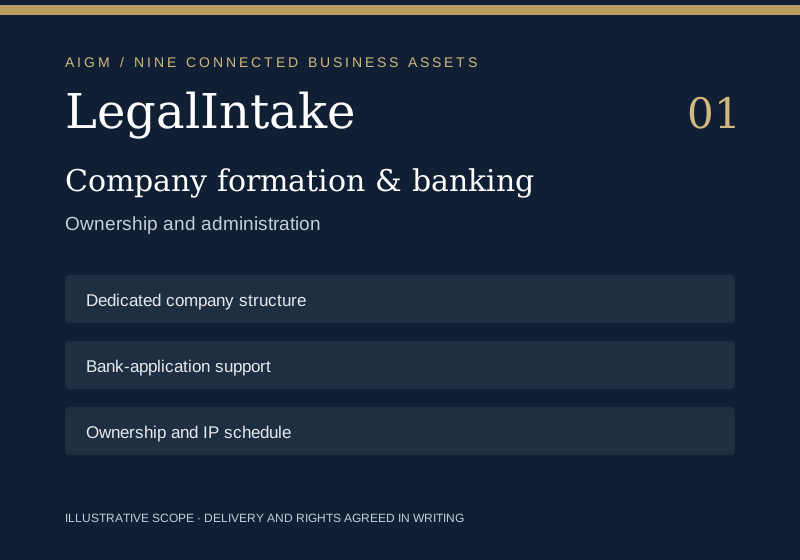
Company formation & banking support
Company incorporation arrangements and support with a business bank application.
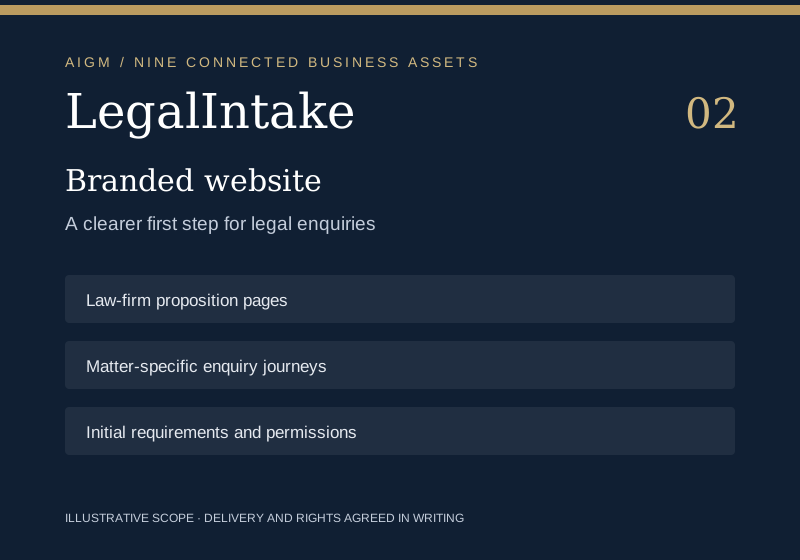
Branded website
A branded website explaining your offer, building enquiries and supporting the customer journey.
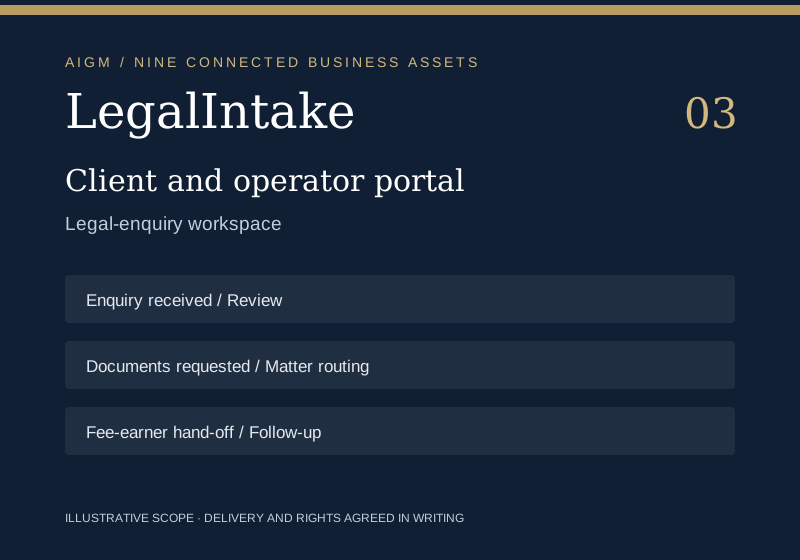
Client or business portal
A customer and operator workspace for the onboarding, documents, tasks and progress specified for your venture.
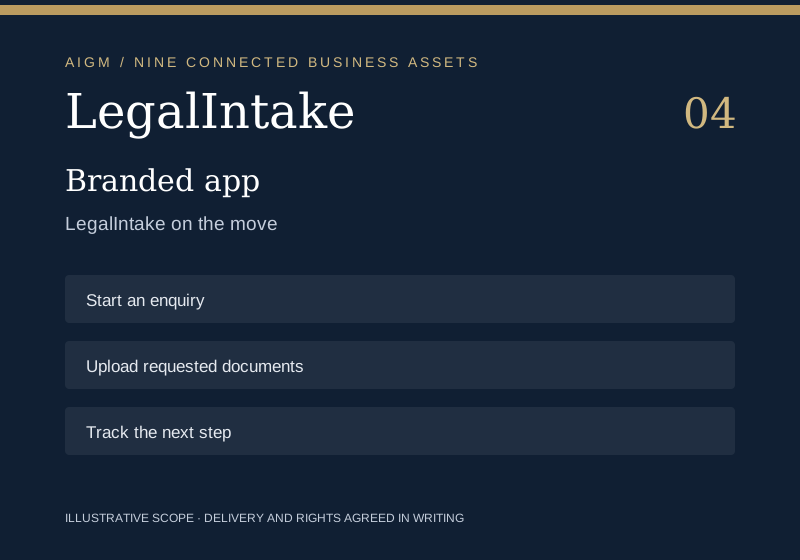
Branded app
A branded app developed to the platform, functions and delivery stage agreed for your company.
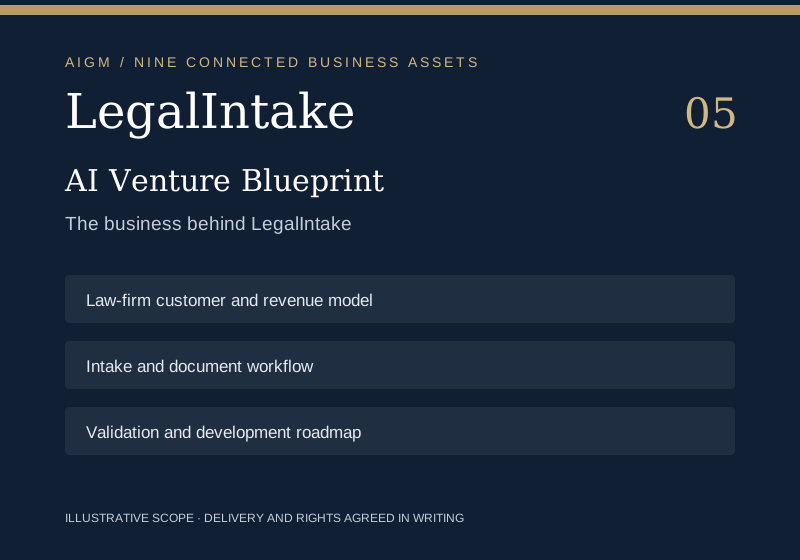
AI Venture Blueprint
A company-specific blueprint connecting the customer, proposition, business model, validation and development roadmap.
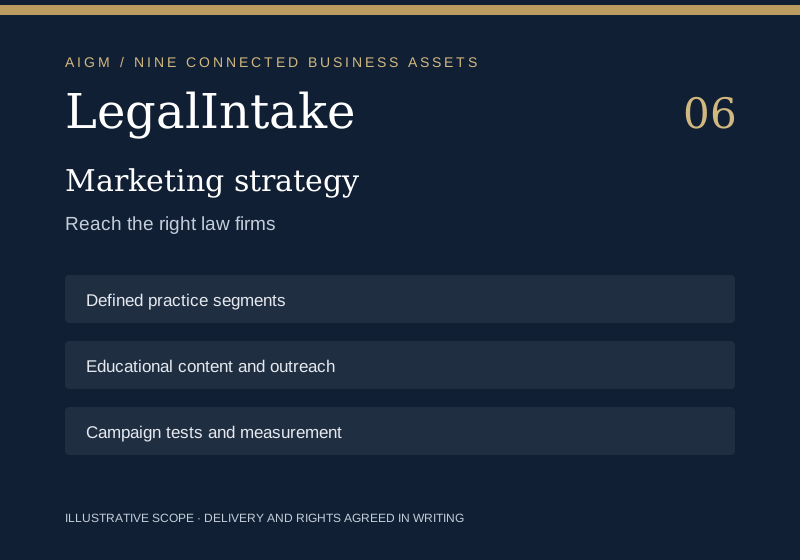
Marketing strategy
Your audience, positioning, offer, channel priorities, first campaigns and measurement plan.
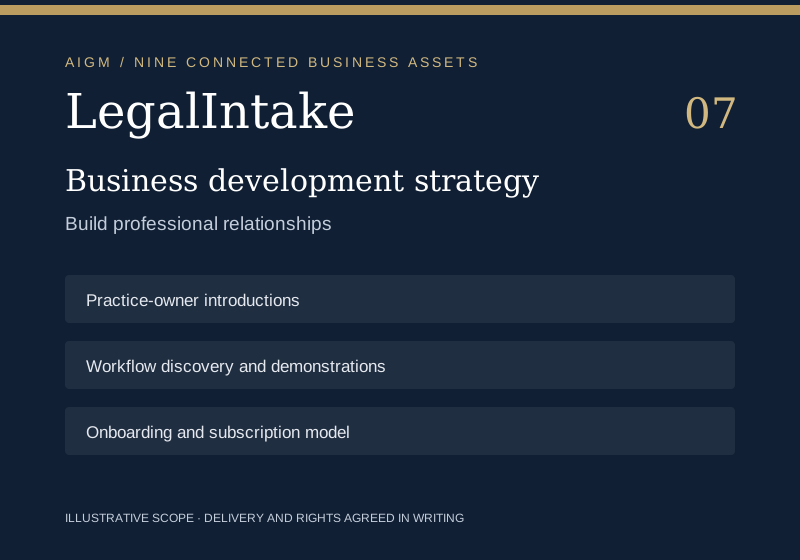
Business development strategy
Your partner priorities, outreach approach, referral opportunities, sales pipeline and follow-up process.
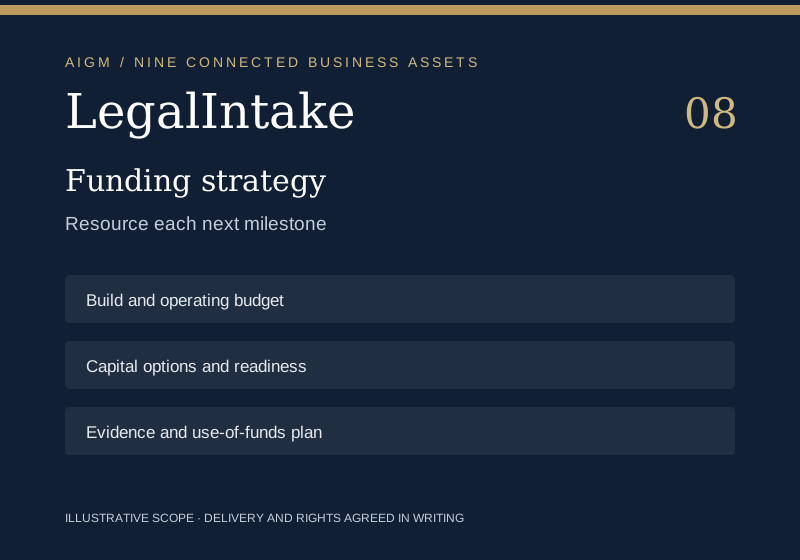
Funding strategy
A costed plan connecting your capital requirement, use of funds, development stages and suitable funding routes. Funding is not included or guaranteed.
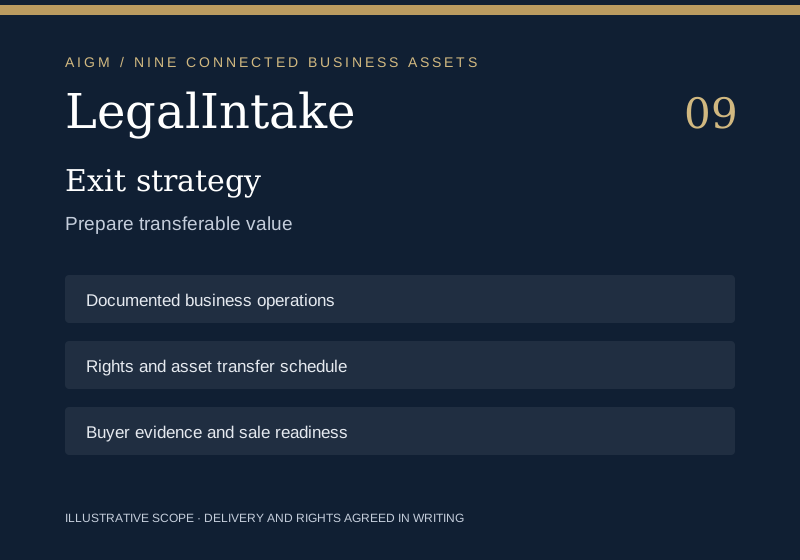
Exit strategy
A plan for potential buyer routes, transferable assets and the commercial evidence that could support a future sale.
Nine assets / One connected company package
See what comes together.
Then see the package price.
The nine categories above are brought together around one business model and one agreed delivery plan.
AiGM standalone scope estimates **
AiGM’s individual prices.
Spread the initial fee.
£950 on engagement, then four monthly payments of £950. A further £4,750 is payable on receipt of agreed funding. Total package fee: £9,500, plus VAT where applicable.
Funding is not guaranteed. Funding-trigger terms, delivery stages, provider fees and ongoing costs are agreed before commitment. Payment and offer details **
Ask AiGM for a written proposal and available payment arrangements for the £19,000 standard package.
LegalIntake visuals are illustrative examples. Your specification identifies existing work, what will be developed and acceptance milestones. Bank approval and any app-store publication are subject to provider requirements. Package details **
The AiGM Delivery Commitment
Clear deliverables.
A clear commitment.
We agree your deliverables, milestones and acceptance criteria in writing. If an agreed deliverable falls short, we put it right within the agreed remedy period. If we cannot resolve it, the agreement provides a proportionate refund for the affected work. Work not supplied is addressed under the agreed cancellation and refund terms.
Your agreement sets out the review process, remedy period and refund calculation before you pay. This commitment concerns delivery of agreed work, rather than revenue, funding, company value or a future sale. Applicable statutory rights remain unaffected. Delivery commitment and refunds **
AiGM Company Market / Planned for Q1 2027
Buy. Build. Prepare to sell.
A planned route to your next buyer.
After at least one year of ownership and development, you can ask to explore a potential resale through the planned AiGM Company Market service. Build towards that option with customer evidence, reliable reporting, documented operations and transferable business assets.
Planned for Q1 2027, AiGM Company Market is intended to give owners a dedicated route to prospective buyers once their business is ready. The proposed service includes sale-readiness assessment, an information memorandum, data-room preparation, buyer enquiries and transaction coordination. An asset sale and a share sale are different transactions; the appropriate structure and any specialist or regulated work must be assessed separately.
Launch: Q1 2027.
Access will depend on eligibility, readiness, separate terms and fees, and the applicable legal and regulatory route. Resale support is not included in the £9,500 package unless expressly agreed. There is no buyback, guaranteed listing, buyer, sale price or completion date. Resale service details **
A funding strategy built around your company
Plan the capital.
Build the capabilities.
Fund the next stage.
A strong opportunity needs a credible plan for paying for development, reaching customers and growing. AiGM’s funding strategy connects the business you want to build with the capital, evidence and milestones each stage could require.
Every funding strategy is tailor-made. Raise sizes, timing, investor types and the mix of equity, founder capital, grants or lending vary with the opportunity, sector, eligibility, traction and founder objectives. The aim is to identify suitable capital for the next commercial milestone.
What your strategy can cover
- Capital requirement, cash runway and a staged use-of-funds budget.
- Product development, agentic AI agents, integrations, testing and implementation.
- Marketing, customer acquisition, people, specialist support and working capital.
- Funding routes, investor fit, eligibility checks and advance-assurance considerations.
- Financial assumptions, valuation scenarios, ownership dilution and milestones for the next raise.
- Readiness gaps and the pitch, financial model and evidence needed for investor discussions.
Illustrative early-stage plan
£50,000 pre-SEIS
+ £200,000 SEIS
= £250,000 total.
The first £50,000 could support validation and an initial product; the following £200,000 could support further development, agreed agents and market entry. These are example planning amounts, not a fixed package or commitment from investors.
Funding examples are illustrative. SEIS eligibility and sequencing require company-specific review. Details **
A potential pathway from first capital to scale.
These are possible stages, not compulsory steps. EIS and SEIS describe tax schemes; Series A, B and later rounds describe financing stages. They may overlap where a round meets the relevant rules.
01 / Pre-SEIS
Prove the opportunity.
Early founder, angel or other capital can fund research, validation and a first product. “Pre-SEIS” is not a standalone HMRC relief and does not automatically make an investment eligible for later SEIS relief.
02 / SEIS
Fund the early build.
The Seed Enterprise Investment Scheme can help qualifying young companies attract seed investors. A company can receive up to £250,000 under SEIS in total, subject to eligibility and applicable aid rules. It is not an annual allowance.
03 / EIS
Support the next growth phase.
The Enterprise Investment Scheme can support eligible companies with development and expansion capital. For most qualifying companies, current relevant-investment limits are £10 million in a rolling 12-month period and £24 million over the company’s lifetime.
Funding limits and eligibility vary by company and investment history. Details **
04 / VC · Series A
Scale a model with evidence.
Institutional venture investors typically look for a credible team, customer traction and a business model capable of substantial growth. A Series A round can fund product depth, sales capacity and expansion.
05 / VC · Series B, C, D and beyond
Finance larger ambitions.
Later rounds can support market expansion, infrastructure, acquisitions or international growth. Conventional VC has no universal SEIS/EIS-style statutory fundraising ceiling. The achievable amount depends on investor mandates, evidence, valuation, dilution and agreed terms. Any tax-relieved portion still has to meet its scheme limits.
Why SEIS and EIS can attract investors.
SEIS investor reliefs
Eligible investors may claim 50% Income Tax relief on qualifying investments of up to £200,000 per tax year, limited by their tax liability. Potential benefits also include CGT exemption on qualifying share gains, relief on 50% of qualifying reinvested gains and eligible loss relief.
EIS investor reliefs
Eligible investors may claim 30% Income Tax relief on up to £1 million per tax year, or £2 million where the required amount is invested in knowledge-intensive companies. Potential benefits include CGT exemption on qualifying share gains, CGT deferral and eligible loss relief.
Tax relief is conditional and capital remains at risk. Details **
An established UK investment market.
HMRC’s provisional figures show £1.575 billion raised through EIS and £276 million through SEIS in 2024-25. This demonstrates an active market for eligible opportunities. Individual raises remain competitive: a relevant network, credible proposition and convincing evidence matter.
Where suitable, the strategy can identify relevant investor networks and specialist fundraising partners. Introductions, investor access and execution support are agreed separately; a strategy does not itself secure funding.
Company limits and investor reliefs checked November 2026. Sources: HMRC SEIS company guidance · annual EIS limits · lifetime EIS limits · investor tax reliefs · HMRC market statistics · equity funding stages.
An exit strategy built around your ambitions
Build a company worth owning.
And one someone else
could want to buy.
Your company could create income, long-term wealth or the opportunity for a significant future sale. The right strategy starts with what you want: a complete exit, some cash out while you keep building, a succession plan, or access to public capital.
AiGM helps you build with those options in mind. We connect your intended outcome with the business model, technology, ownership, financial evidence and management capabilities a future buyer or investor would need to see.
Different ambitions. Different routes.
01 / Strategic trade sale
Become valuable to a bigger player.
A competitor, platform or industry group may value access to your customers, technology, team or market position. The strategy asks who could benefit from owning your business, why it fits their priorities and what evidence would make that case compelling.
For a relevant property-technology venture, a group such as Rightmove could be one research candidate. Rightmove’s acquisition of HomeViews illustrates activity in adjacent property services. It does not establish interest in any AiGM venture.
02 / Full or partial equity sale
Take some value off the table.
A private equity investor, family office or other buyer may acquire all or part of a company. A partial sale can release some founder value while retaining an ownership stake. The outcome depends on the terms, including any reinvestment, future control and ongoing management role.
03 / Management buyout
Hand over to the team.
An established management team may buy the business, subject to finance and agreed terms. We can assess the commercial readiness of this route: management depth, reliable cash generation, a credible succession plan and the transition away from founder dependence.
04 / Succession or employee ownership
Choose who carries it forward.
A family succession or an employee-ownership structure may fit owners who prioritise continuity and legacy. We help compare the commercial implications; specialist advisers assess legal structure, funding and tax eligibility before implementation.
05 / Merger or buy-and-build
Join forces before a later exit.
Combining complementary businesses may create a broader offer, stronger distribution or a more attractive acquisition target. The strategy tests integration, ownership, economics and what a larger group could achieve. A merger may defer liquidity rather than deliver an immediate cash exit.
06 / IPO or public-market admission
Explore a public future.
An IPO can provide growth capital, a wider shareholder base and a potential route to partial shareholder liquidity. It is usually a new stage in the company’s development, rather than an immediate full founder exit. Lock-ins, trading liquidity and market conditions affect when shares can be sold.
Think beyond the largest stock-market names
“We’re too small for an IPO.”
Have you explored the right market?
If your picture of an IPO is a major NYSE or London Main Market flotation, it is understandable to assume the route is out of reach. Public markets also include growth-company venues, with admission frameworks designed for a different stage of business.
Nasdaq First North, Sweden
Nasdaq First North Growth Market includes a Swedish venue and forms part of Nasdaq’s Nordic and Baltic growth-market offering. It serves growth companies seeking public capital and visibility. It is an SME growth market, distinct from Nasdaq’s regulated Main Market.
Applicants need to meet the applicable admission requirements and appoint a Nasdaq-approved Certified Adviser, retained throughout their time on the market. Governance, financial information, organisation, disclosure and investor interest all matter.
London has growth-market options too.
AIM, operated by the London Stock Exchange, is designed for small and medium-sized growth companies. It requires a nominated adviser and appropriate preparation, reporting and continuing compliance.
The useful question is which venue, investor base and cost structure fit your business, if any. A smaller-company market is not an automatic or inexpensive route to a flotation.
Size alone should not end the conversation. Readiness, a credible growth story, investor demand and the economics of becoming a public company are decisive. Admission fees, advisers, audit, governance, disclosure and ongoing investor relations must all be budgeted.
How AiGM helps you prepare.
Choose a route that fits you.
- Clarify your desired proceeds, timing, control and future involvement.
- Compare sale, succession, partial liquidity and public-market scenarios.
- Research buyer categories and their potential strategic rationale.
- Test valuation assumptions, dilution and headline value versus potential net proceeds with your advisers.
Build the evidence behind the ambition.
- Plan recurring revenue, margins, retention and transferable customer relationships.
- Identify founder dependence, IP ownership and documentation gaps.
- Develop a roadmap for reporting, management depth and a transaction-ready information set.
- Coordinate agreed commercial preparation with the relevant corporate-finance, legal, tax and listing specialists.
Whether your best fit is a strategic sale, a management handover, a staged exit or a future IPO, the strategy is tailored to your company. You can also choose to retain ownership and build a stronger income-producing business. We review the options as evidence and circumstances develop.
Exit execution and specialist fees are separate. A sale or valuation is not guaranteed. Details **
Sources: British Business Bank: sale routes · investor exits · Nasdaq First North · London Stock Exchange: AIM · Rightmove: HomeViews acquisition.
Traditional to Tech
Acquire an established business.
Build its technology-led future.
You don’t always need to start a new company to transform an industry. Sometimes, the opportunity is to acquire a traditional business and reinvent how it works.
An established company may already have customers, revenue, relationships and a recognised position in its market. Your opportunity is to combine those foundations with AiGM’s commercial strategies, AI capabilities and technology development.
Traditional property business→PropTech company
The ambition is to create a more efficient, scalable company with a stronger customer proposition and greater potential value.
Find the business. Shape the opportunity.
Build the transformation.
01Identify the right acquisition.
Source a traditional business in an industry you understand. Look for established customer demand, credible trading performance and opportunities to improve its service, costs or business model.
02Explore a workable acquisition structure.
Depending on the opportunity, this could involve acquisition finance, seller finance, deferred consideration or a combination of funding sources. In suitable circumstances, a structure may require little or no upfront purchase-price contribution from the buyer.
03Develop your Traditional to Tech strategy.
AiGM can help define the commercial model, customer experience, digital platforms, integrations and agentic AI capabilities that could transform the business. We prioritise development around measurable commercial benefits.
04Build towards growth and future value.
Connect the transformation plan with customer acquisition, funding requirements and potential exit routes. The objective is a stronger business with capabilities that customers value and future buyers could find attractive.
How AiGM can help
We can help assess the transformation opportunity, develop your commercial and technology roadmap, and connect development priorities with funding and exit planning. Acquisition advice and execution would be coordinated with appropriate legal, accounting and finance specialists.
Bring your industry knowledge. Find an established opportunity. Explore what it could become with AiGM.
Acquisitions require due diligence, costs and a viable funding structure. Details **
For AiGM company-package clients / Selected partnerships
Build your company.
Could we build further together?
Paul Johnson is keen to explore joint ventures with serious, professional and ambitious business owners and entrepreneurs who bring a compelling opportunity and the commitment to develop it.
Once you have purchased your AiGM company package, you can request a conversation with Paul about whether a closer commercial partnership could make sense.
Your industry expertise, customer relationships, market access or distinctive intellectual property could be the foundation. Your ambition matters, and so does the evidence of what you can contribute.
A conversation for the right fit.
Paul considers proposals individually, looking for complementary capabilities, clear customer demand, aligned ambitions and an owner ready to help build and operate the business.
The starting question is simple: what could we achieve together that creates a stronger business?
Selected on merit.
Agreed separately.
A further collaboration could be fee-based, equity-based or a combination, depending on the contributions and commercial fit.
Buying a package does not secure a JV, equity participation, investment or free development. Any partnership requires mutual agreement and separate written terms covering contributions, ownership, IP, funding, responsibilities and costs.
Build the foundation. Demonstrate what you bring. Then explore whether our ambitions align.
Already a company-package client? Request a partnership conversation with Paul ↗
Exploring your first company package?
Optional development / Beyond the nine business assets
Build the AI workforce
behind your company.
AiGM can design and develop specialist agentic AI agents around your company’s customers, processes and commercial model. These agents can use approved information and connected systems to carry out defined tasks, coordinate workflows and pass exceptions to your team.
Potential applications include enquiry qualification, customer onboarding, document collection, quotation preparation, marketing follow-up, task coordination and management reporting. Each build defines what agents can do, which actions require approval and when a person takes over.
Plan the agents. Build after funding.
For many ventures, agent development would follow receipt of the required funding. We can map the proposed agents, priorities, development stages and estimated costs into your funding strategy and use-of-funds plan, so the raise reflects the company you intend to build.
Want agents from the outset?
Commission an initial agent or a defined set of workflows as a separately priced addition. We agree the specification, integrations, safeguards, testing, payment terms and ongoing costs before development begins.
Agent builds are optional extras and are not included in the nine-asset company package. Your written proposal separates the package scope from additional development, implementation and ongoing services.
An existing foundation. A company that fits you.
You do not have to start from a blank page.
For example, you might like LegalIntake’s legal-enquiry workflow but want it shaped for a particular sector, a different customer journey or your own brand. We assess which parts can be reused and which need changing before agreeing the package.
1. Choose your starting package
Browse the packaged deals above and select the one closest to your opportunity.
2. Tell us what needs to change
Describe your industry, experience, audience and circumstances. We can scope changes to branding, positioning, commercial model, digital workflows and strategies.
3. Agree your personalised package
Your proposal identifies retained and new work, development stages, rights or licences, any exclusivity, delivery milestones, total price and your responsibilities.
Scope and important information **
The thinking behind the business assets
The matrices support the strategy.
These three matrices are examples from AiGM’s wider proprietary venture-creation system, not the complete collection. The system connects opportunity assessment, validation, AI capability, marketing, risk, growth, funding, business value and exit planning. Your company-specific analysis draws on the relevant matrices within the agreed scope.
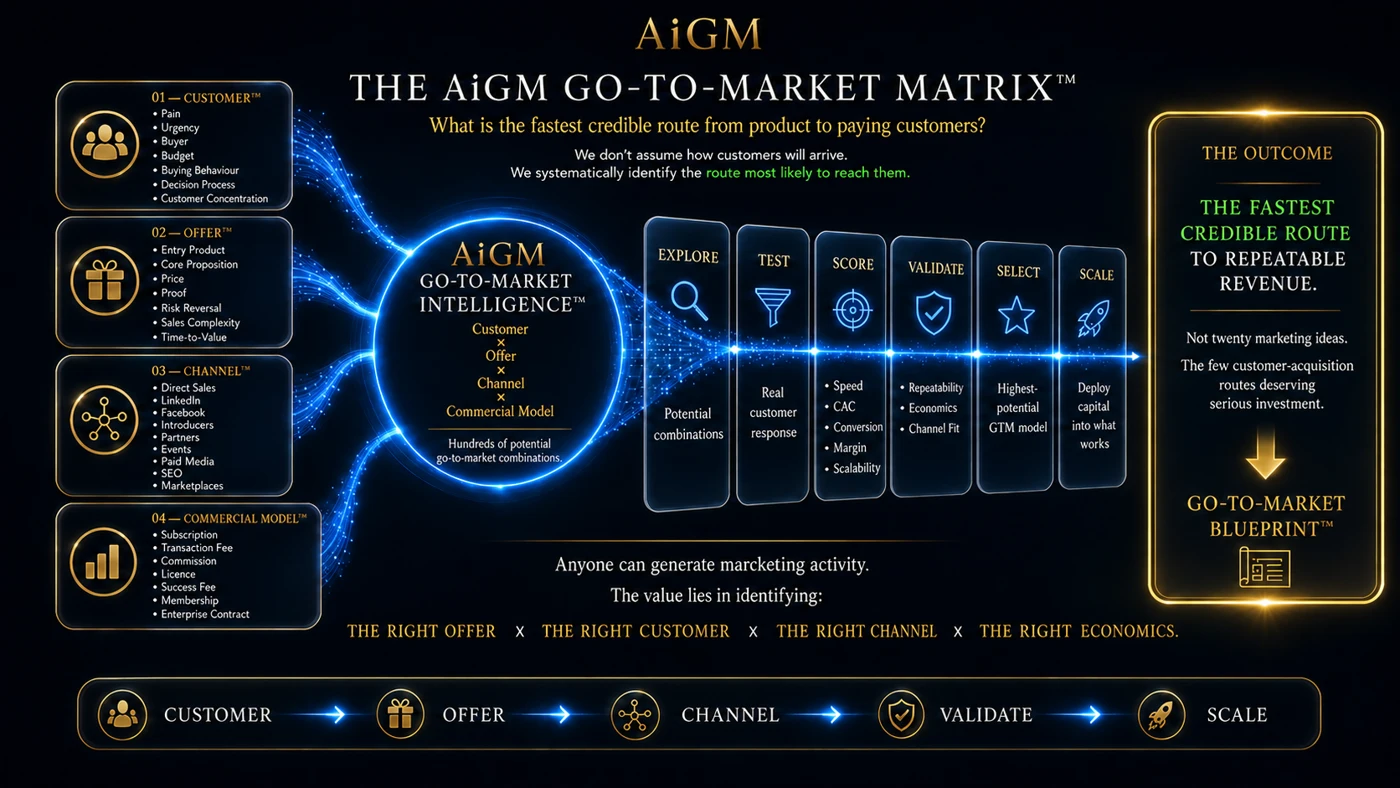
Go-to-Market Matrix
Connect the customer, offer, channel and commercial economics behind the marketing and business development plans.
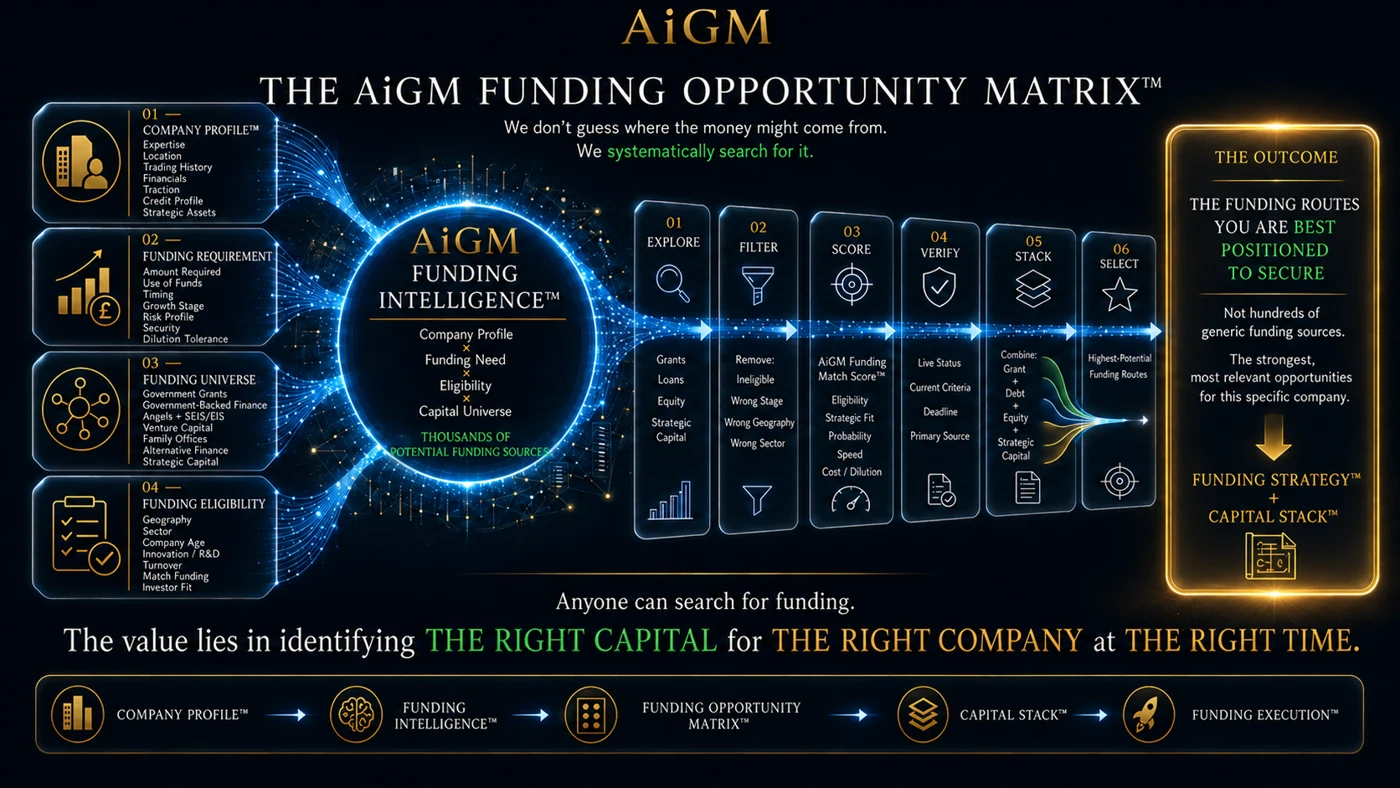
Funding Opportunity Matrix
Assess the company profile, funding requirement, eligibility and potential capital routes.
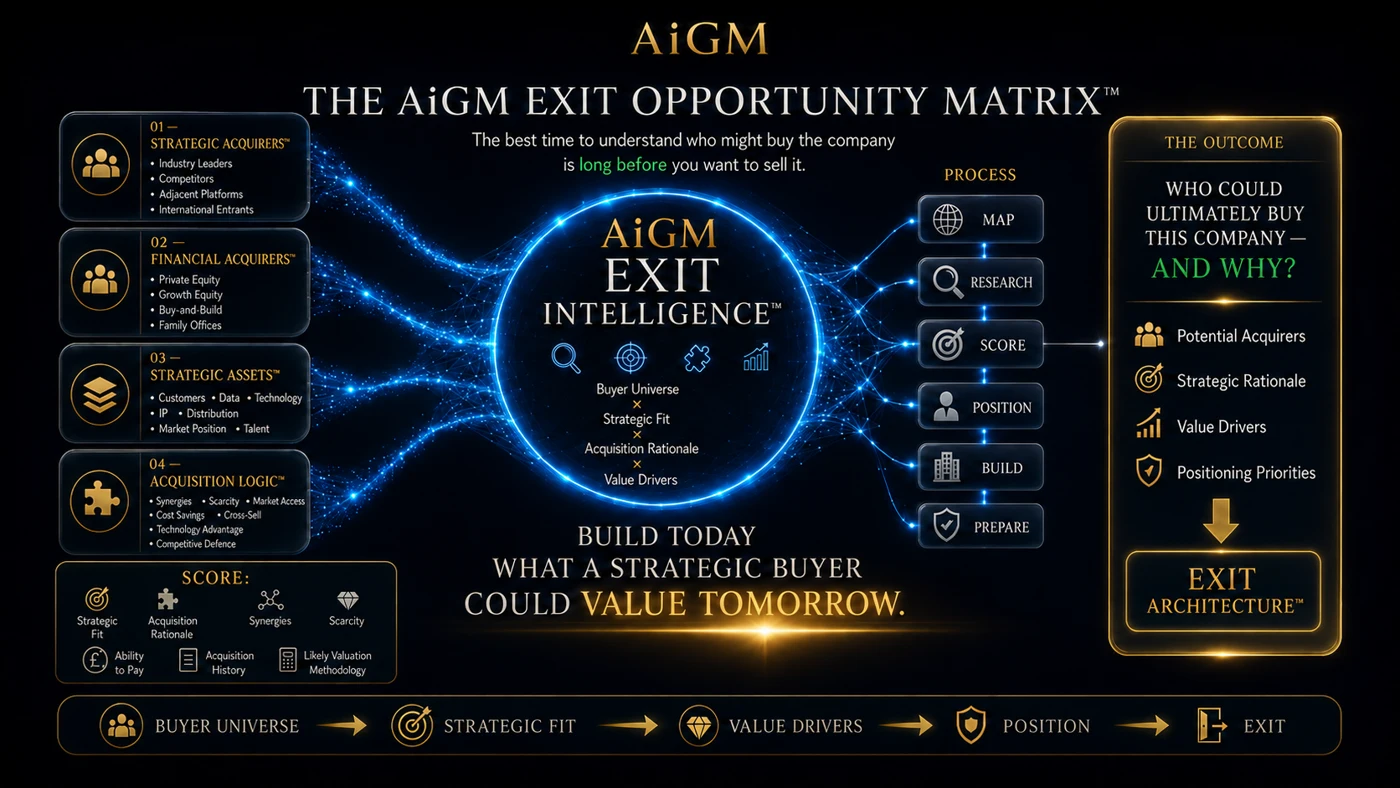
Exit Opportunity Matrix
Examine buyer fit, strategic value and the evidence a future buyer could require.
What you need to know
A clear view of
every opportunity.
What will my agreement include?
Each proposal identifies services, assets and technology licences, together with scope, exclusivity and ongoing charges. Any share transaction requires a separately assessed legal and regulatory route.
Do ventures already have customers?
Some opportunities may be pre-revenue. Each proposal should identify actual trading evidence, working functionality and assumptions separately.
Can I explore a partnership with Paul after purchasing?
Yes. Company-package clients can request a conversation with Paul about a potential further collaboration. He considers the opportunity, your contribution, evidence and commercial fit individually. Fee-based, equity-based or mixed arrangements require separate agreement. Purchasing a package does not guarantee a partnership, investment or free development.
How does the funding strategy work?
We map the uses of funds to development and launch milestones, then assess suitable routes such as founder capital, grants, lending or equity where appropriate. The plan identifies eligibility, evidence gaps, likely costs, timing and dilution. A target raise is an assessment, not a funding commitment. Specialist advice and any regulated activity require the appropriate providers and legal route.
How do you plan for a future exit?
We identify plausible buyer types and the evidence that could make a business attractive: customer demand, recurring income, margins, transferable intellectual property, documented operations and reliable reporting. The roadmap can consider strategic acquisition, management succession or continued ownership. Buyer names are research hypotheses, not expressions of interest. A sale, timing, valuation or multiple cannot be promised.
What further investment is required?
Your proposal will identify the purchase or engagement fee, development scope, operating costs and additional launch funding required.
What happens when you proceed?
Receive your proposal, deliverables schedule, terms and payment arrangements before payment. Accept the agreement, then receive your invoice or payment receipt, signed copy, onboarding questionnaire, project plan and kickoff arrangements. Delivery and any funding-dependent balance follow the agreed contract.
Scope and important information **